Environmental burden of disease calculation
See also: Environmental burden of disease methodology, (EBD) Plass et al. (2024).
In Figure 116, the attributable burden (in DALY s) with uncertainty bounds are displayed together with the cumulative percentage (right axis). On the x-axis, the exposure is displayed according to the specified bin boundaries, see settings. Specify custom bins or exposure response function ( ERF) defined bins (i.c. 5, 10, 25, 50, 75, 90, 95%).
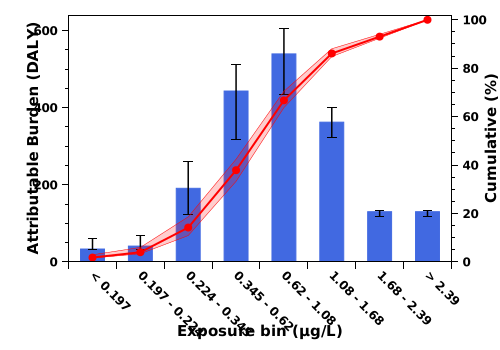
Figure 116 Attributable burden & cumulative percentage with ERF defined bins
In Figure 117, the attributable burden is standardised by the population size (see primary entity populations data format) and expressed per 100,000 individuals. Population size can be expressed with uncertainty that is propagated through the calculations.
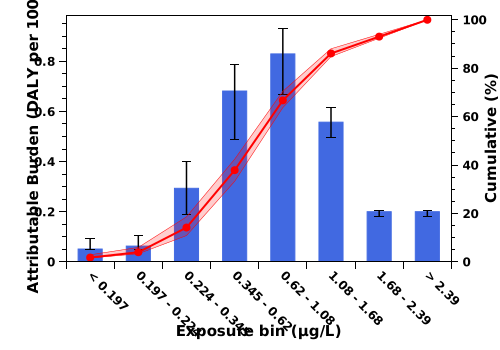
Figure 117 EBD per 100,000 individuals & cumulative percentage with ERF defined bins
Figure 118 shows the exposure response function, here an odds-ratio. Note that a confidence interval for the effect metric OR (odds ratio) is provided with a lower bound below 1, suggesting a health benefit. This is undesirable and the user should be able to force PAF values to have a lower limit of 0. Use setting ‘Forces PAF values to a minimum of 0’ to force the \(PAF>0\) (only in a top down approach). The vertical red line indicates the counterfactual value of the ERF at 0.5.
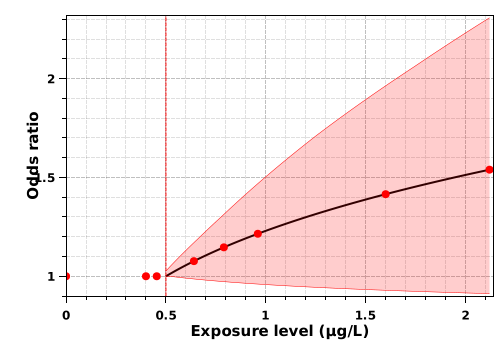
Figure 118 Exposure response function, effect metric is odds-ratio