Exposure mixtures calculation
The most common approach to cumulative risk assessment is to focus on substances belonging to the same common assessment groups (CAG). Substances within such a group often share a chemical family and may or may not exhibit a similar mode of action. In risk assessments, potential interactions between substances are frequently ignored; furthermore, limited information is available regarding synergistic effects at low doses. While more data on the combined effects of these substances is needed, investigating all possible mixtures is impractical. Therefore, prioritization tools are required to select the most relevant substances for further study. This selection should be based not only on the hazard (highest relative potencies) but also on the exposure of the population to these substances. The potential risk of mixture exposure depends on individual food consumption patterns of individuals in a population. ince a regular diet can contain hundreds of substances, the number of potential combinations is vast. The exposure mixtures module is used to identify the most relevant components and substance combinations to which a population is exposed.
Risk based, standardised or unweighted exposures
Before performing the mixture exposure assessment, the data are preprocessed. Three optional choices are available, see settings, exposure approach type.
Risk based exposures: exposures are multiplied by the relative potency factor (\(\operatorname{RPF}\)) of each substance and thus exposures for different substances are on the same and comparable scale.
Standardised exposures: all exposures are standardised to equal variance (unit variance).
Unweighted exposures: exposures are taken as such, this is equivalent to \(\operatorname{RPF}\) s equal to 1 for each substance.
Exposure mixtures are identified using a quantitative approach: sparse non-negative matrix underapproximation (SNMU) (Gillis and Plemmons (2013)) and answers the question what combination of substances predominantly determine the underlying patterns in the exposure matrix (substance x person (day)).
After identifying the components, a cluster analysis is applied to group individuals with similar profiles of exposure to the obtained component (Crépet et al. (2022)).
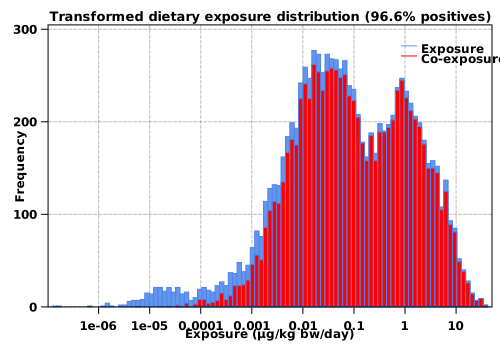
Figure 82 Example of co-exposure distribution (from >1 substance per individual-day, red) super-imposed on the total exposure distribution (blue).