Maximum Cumulative Ratio
Price and Han (2011) propose the Maximum Cumulative Ratio (\(\operatorname{MCR}\)) which is defined as the ratio of the cumulative exposure received by an individual on an intake day to the largest exposure received from a single substance:
This \(\operatorname{MCR}\) statistic is also picked up as a practical device in a recent JRC report, Bopp et al. (2015), to investigate cumulative exposure. If \(\operatorname{MCR}\) is large, it is important to consider cumulative effects. If \(\operatorname{MCR}\) is close to 1, the individual exposure does not differ significantly from a single-substance assessment. The \(\operatorname{MCR}\) can therefore be interpreted as the degree to which the risk is underestimated when a cumulative risk assessment is not performed.
The \(\operatorname{MCR}\) statistic is implemented in MCRA for both acute and chronic exposure assessment. In an acute exposure assessment, short-term (single-day) exposures are used. For the chronic case, long-term individual exposures — estimated by aggregating the available survey days for each individual — are used.”.
Exposure assessment
Risk based, standardised or unweighted exposures
Before calculating the \(\operatorname{MCR}\) statistics, three optional choices are available, see settings, MCR exposure approach type.
Risk based exposures: exposures are multiplied by the relative potency factor (\(\operatorname{RPF}\)) of each substance and thus exposures for different substances are on the same and comparable scale.
Standardised exposures: all exposures are standardised to equal variance (unit variance).
Unweighted exposures: exposures are taken as such, this is equivalent to \(\operatorname{RPF}\) s equal to 1 for each substance.
Table 273 shows an artificial example how the \(\operatorname{MCR}\) is calculated in an acute exposure assessment. First the cumulative exposure per day is calculated by cumulating the exposure of each substance multiplied by the \(\operatorname{RPF}\). Then, for each day, the cumulative exposure (in equivalents of the reference substance) is divided by the maximum exposure of a single substance on that day. The last column shows the \(\operatorname{MCR}\) values, with the substance with the highest exposure in parenthesis. The \(\operatorname{MCR}\) has a value of 1, or close to 1, for mixtures where the exposure is dominated by one substance (e.g. day 1, substance B). When all substances have approximately equal exposure (e.g. day 3) the \(\operatorname{MCR}\) value is equal or close to the number of substances, here 4. Day 2 represents an intermediate case. The \(\operatorname{MCR}\) suggest that for exposure days (or persons) with \(\operatorname{MCR}\) values close to 1, the need for a cumulative risk assessment is low.
Substance A |
Substance B |
Substance C |
Substance D |
total exposure |
ratio |
|
|---|---|---|---|---|---|---|
day 1 |
0.01 |
0.99 |
0 |
0 |
1 |
1.01 (B) |
day 2 |
0.1 |
0.2 |
0.3 |
0.4 |
1 |
2.50 (D) |
day 3 |
0.25 |
0.25 |
0.24 |
0.26 |
1 |
3.99 (D) |
In this artificial example, all days have equal values for total exposure (= 1). “n real-world data, total exposure varies. It is therefore of interest to determine whether the \(\operatorname{MCR}\) is high or low on days (or for individuals) where the total exposure is at its peak.
In Figure 77, French steatosis data (39 substances, 4079 persons) are used to calculate the chronic exposure matrix. For each individual \(\operatorname{MCR}\) is calculated and plotted against the total exposure. Different colours are used to distinguish the substances with the highest exposures. From the 39 original substances, 10 were identified as the primary drivers. The black line segments indicate the \(p_{5}\), \(p_{50}\) and \(p_{95}\) percentiles for both total exposure and \(\operatorname{MCR}\). The red line marks a ratio of 5, while the dashed green lines represent the \(p_{95}\) percentiles for \(\operatorname{MCR}\) across various total exposure ranges.
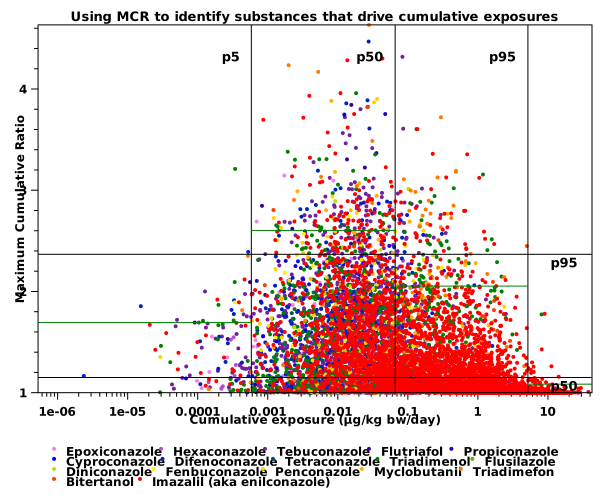
Figure 77 Maximum Cumulative Ratios vs total exposure
The plot shows that \(\operatorname{MCR}\) values with Imazalil as risk-driving substance (purple) are predominantly found in the lower part of the plot at relatively high values of total exposure. Secondly, \(\operatorname{MCR}\) values decline as total exposure increases. This implies that cumulative exposure for most individuals is driven by multiple substances. At the right site of the plot, individuals with high exposure are found. Because \(\operatorname{MCR}\) values tend to be lower in this region, higher exposures are driven by one predominant substance rather than by multiple substances being above the average level. For those individuals, a cumulative risk assessment has limited added value.
Because the Figure 77 plot can be very dense, in Figure 78, 95% confidence regions representing bivariate lognormal distributions of \(\operatorname{MCR}\) and total exposure are plotted. The latter figure facilitates interpretation of the former. Note that substances with only one or two observations cannot be visualized in this display (substances with 2 observations are represented by a line).
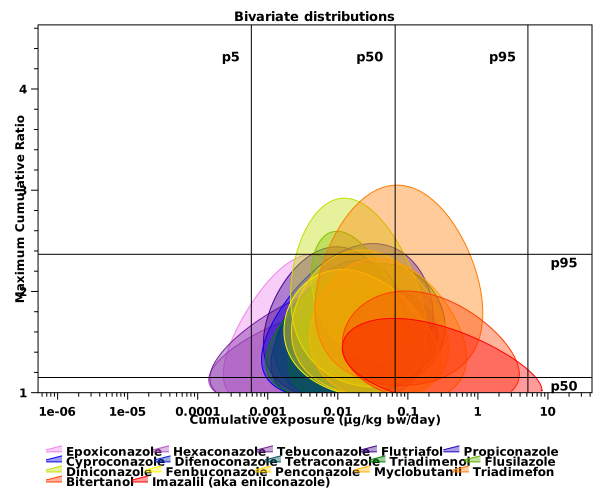
Figure 78 Bivariate distributions \(\operatorname{MCR}\) vs total exposure
In Figure 79 and Figure 80 scattered \(\operatorname{MCR}\) distributions for the total and upper tail (here 37%) that drive the cumulative exposure are shown. The red line indicates the \(\operatorname{MCR}\) threshold, 1.5. The black lines represent the regression lines \(\operatorname{MCR}\) vs ln(Cumulative exposure) for each tail. Substances with an exposure contribution less than 15% are not displayed.
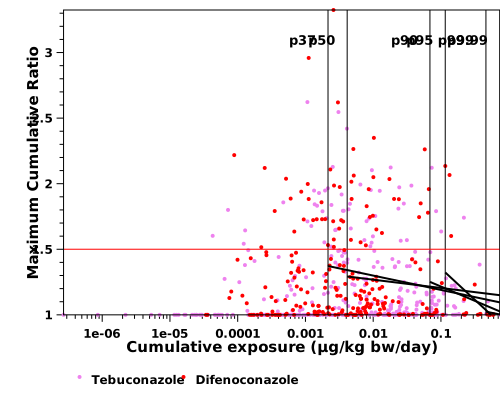
Figure 79 Using \(\operatorname{MCR}\) to identify substances that drive cumulative exposures, scatter distributions (total).
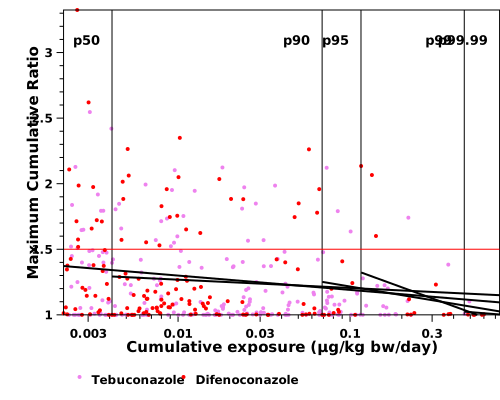
Figure 80 Using \(\operatorname{MCR}\) to identify substances that drive cumulative exposures, scatter distributions (upper tail 37%).
In Table 274 contributions to tail exposures at various percentile are shown. Column \(\operatorname{MCR} = 1\) shows the percentage of tail exposure due to individual(day)s with a single substance. Column \(1 < \operatorname{MCR} ≤ 2\) shows the percentage of tail exposure due to individual(day)s with multiple substances, but the \(\operatorname{MCR} ≤\) 2. Column \(\operatorname{MCR} > 2\) shows the percentage of tail exposure due to individual(day)s with multiple substances with \(\operatorname{MCR} > 2\).
Tail % |
% with MCR = 1 |
Substances |
% with 1 < MCR<=2 |
Substances |
% with MCR > 2 |
Substances |
|---|---|---|---|---|---|---|
37 |
20.6 |
Difeno, Tebu |
73.7 |
Difeno, Tebu |
5.7 |
Difeno, Tebu |
50 |
19.2 |
Difeno, Tebu |
75.6 |
Difeno, Tebu |
5.2 |
Difeno, Tebu |
90 |
16.3 |
Difeno, Tebu |
78.8 |
Difeno, Tebu |
5.0 |
Difeno, Tebu |
95 |
15.0 |
Difeno, Tebu |
82.5 |
Difeno, Tebu |
2.5 |
Difeno, Tebu |
99 |
25.0 |
Difeno |
75.0 |
Difeno, Tebu Propi |
0.0 |
To configure the \(\operatorname{MCR}\) plot, see dietary exposures settings, human monitoring analysis settings and internal exposures settings with options to display the ratio total exposure/ maximum for individual(day) exposures (MCR plot), to specify tail percentiles of the exposure distribution, e.g. 95, 97.5 and 99% (MCR plot) or to set the minimum percentage contribution per substance to the tail exposure (MCR plot).
Risk assessment
Recently, a new plot was added that is especially useful for a risk assessment approach (Kortenkamp et al. (2022)). In Figure 81 each dot represents the \(\operatorname{MCR}\) of an individual, the sum of risk characterisation ratios divided by the ratio of the highest contributing substance. The blue area, where \(E/H < threshold\), marks combined exposures that do not present any concern. The white area - defined by the vertical red line for acceptable risks and the curved line depicting \(E/H = threshold * MCR\) (with a default threshold of 1) - shows subjects with combined exposures above the threshold (\(E/H > threshold\)) but whose risk quotient for any single substance does not exceed the limit. The red area represents subjects where \(E/H > threshold\) and where exposures produce risk quotients exceeding the threshold for at least one substance. Data points below the horizontal red line (corresponding to MCR = 2) indicate subjects where one substance contributes 50% ore more to the total risk (e.g. single substance issue). Above the line, subjects experience combined exposures from multiple substances (e.g. co-exposure).
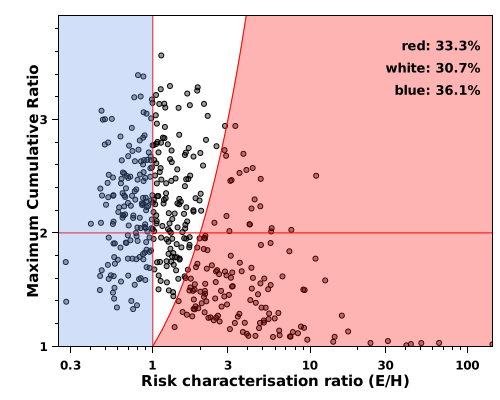
Figure 81 Using \(\operatorname{MCR}\) to identify substances that drive cumulative risk, scatter distributions (total).