Internal exposures calculation
The main goal of the internal exposures module is to calculate the exposure as an internal concentration or internal dose. The internal concentration refers to the amount of chemical present in a specific target, tissue or (biological matrix) using kinetic conversion factors or PBK models. The internal dose is the amount of chemical that is systemically available using absorption factors and is the fraction of the external dose that is absorbed and enters the general circulation, see also WHO, Chapter 5 (2008). External exposures from dietary and non-dietary sources (including dust, air, soil and consumer products) are aggregated at a specified internal level in two steps:
Linking dietary and/or non-dietary individual/individual-day exposures.
Computing the (aggregated) internal exposures at the specified internal level concentration or dose.
Absorption factors are just simple multiplication factors and aggregate the exposure from multiple routes into an internal dose, see also module kinetic conversion factors. Kinetic conversion factors or more advanced PBK models aggregate the exposures from multiple routes into an internal concentration at a specified target (biological matrix). Currently, dietary exposures, dust, soil or air exposures or non-dietary exposures are aggregated to an internal level.
In cumulative internal exposure calculations two simple approaches are used to identify and select mixtures contributing to the exposure of a target population:
qualitative approach: counting of co-exposure. To which combinations of substances are individuals exposed? Just the co-occurence of substances is observed.
quantitative approach: maximum cumulative ratio (MCR). To what degree are mixtures more important than single substances? The relative exposure levels of the substances present in a measurement, e.g. an individual (chronic) or individual day (acute) are taken into account.
In the exposures mixtures module, two more advanced approaches are available to analyse the co-occurence of substances, the SNMU approach and a network analysis.
Computation of internal exposures (e.g. an internal doses or internal concentrations) requires absorption factors, kinetic conversion factors or PBK models to translate external doses, possibly from multiple routes, to internal doses (absorption) or concentrations at the target matrix/organ of interest (kinetic conversion).
Calculation of internal doses using absorption factors
In its simplest form, internal doses are derived from external doses using absorption factors specified for each substance and route combination. That is, for a given substance, the internal dose \(\mathit{dose}_{\mathtt{int}}\) is calculated as
Here, \(\mathit{routes}\) denotes the set of external exposure routes, \(\mathit{exp}_{\mathtt{ext},r}\) represents the external exposure for route \(r\) and \(\mathit{f}_{\mathtt{abs}, r}\) is the absorption factor of route \(r\). Note that this model assumes that both external and internal doses refer to amounts or doses consistent with the dietary exposures setting. Specifically, external exposure is expressed as either substance amount per individual or substance amount divided by body weight, while internal exposure is expressed as substance amount per organ or substance amount divided by organ weight. Additionally, both external and internal doses are expressed on a per-day basis.
Calculation of internal concentrations using kinetic conversion factors
Kinetic conversion factors are used to convert an external (administered) dose to a concentration in a target or biological matrix. For a given substance, the internal concentration \(\mathit{conc}_{\mathtt{int}}\) is computed as
Here, \(\mathit{routes}\) denotes the set of external exposure routes, \(\mathit{exp}_{\mathtt{ext},r}\) denotes the external exposure for route \(r\) and \(\mathit{f}_{\mathtt{kc}, r}\) denotes the kinetic conversion factor for route \(r\).
When biological matrix urine is selected, concentrations are interpreted as such or interpreted as standardised by creatinine or normalised by specific gravity. Check option Standardised (creatinine) or normalised (specific gravity) urine concentrations and make a choice between expression type creatinine or specific gravity
When blood is selected as the biological matrix, concentrations are either expressed as such or standardised for lipid content. Check option Standardised blood concentrations (lipids).
Calculation of internal concentrations using PBK models
A more detailed alternative to using kinetic conversion factors is to use one of the advanced kinetic models available in MCRA. In this approach, for each substance independently, the external exposures of an individual (chronic) or individual-day (acute) are input into a PBK model of the individual for a number of simulated days. This yields a time course of the internal substance amount in the specified target or biological matrix from which a long-term average amount (chronic) or peak amount (acute) can be derived. Examples of such time courses are given in Figure 73 for acute exposure assessments, and in Figure 74 for chronic exposure assessments. By dividing this substance amount by the mass of the biological matrix, an internal concentration is obtained. Notice that this procedure also changes the exposure from a daily rate to a long-term exposure.
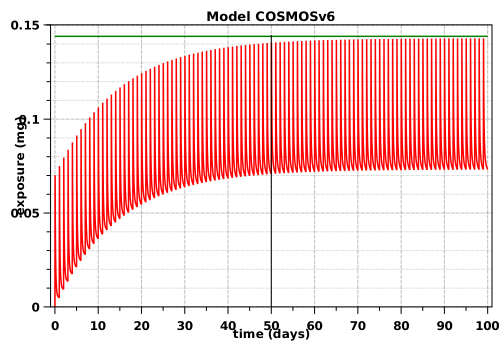
Figure 73 Time course of the internal substance amount when applying the same single dose on each day. The acute internal concentration is derived as the peak substance amount (the green line in the figure) divided by the weight of the biological matrix. The vertical line at 50 indicates the selected end of an assumed non-stationary period, defining a burn-in period that is to be ignored for computing the peak substance amount.
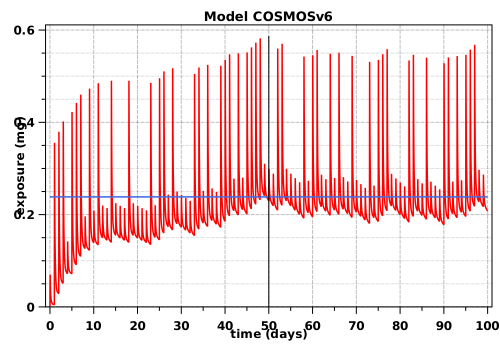
Figure 74 Time course of the internal substance amount when randomly applying one of the individual-day doses for a number days. The chronic internal concentration is derived as the average substance amount (the blue line in the figure), divided by the weight of the biological matrix. The vertical line at 50 indicates the selected end of an assumed non-stationary period, defining a burn-in period that is to be ignored for computing the average substance amount.
Mathematically, the calculation of the peak substance amount (\(\mathit{d}_{\mathtt{peak}}\)) for deriving acute internal concentration is as follows:
Here, \(d(t)\) denotes the substance amount at time \(t\), \(t_{\mathtt{start}}\) denotes the starting time of the evaluation window (defined by the non-stationary period), \(\Delta t\) denotes the time resolution of the kinetic model (e.g., hours or minutes), and \(n_{\mathtt{stop}}\) denotes the total number of time-points, marking the end of the evaluation window (defined by the specified number of simulation days), which is computed as
Likewise, chronic long term average substance amounts (\(\mathit{d}_{\mathtt{avg}}\)) are computed as:
Dosing patterns
In MCRA, dietary and non-dietary exposures are computed as daily exposure levels. However, when applying advanced PBK models, dosing patterns may be specified at a much finer resolution (e.g., hours or minutes). This requires a method to translate daily external exposures into intra day dosing patterns. The simplest, though less realistic, approach is to apply the full daily exposure for each route as a single dose at the start of the day. Alternatively, MCRA allows users to specify the number of exposure events per day per route. When multiple doses are specified, the total daily substance amount is divided into equal portions which are then applied at regular time-intervals throughout the day.
Non-stationary period
Especially in chronic exposure assessments, where a long-term average exposure is computed based on the simulated time-course, it is important to note that at time zero, the substance is typically assumed to be entirely absent from the simulated system. However, this is often an unrealistic assumption. In practice, it is more likely that the substance is already present at a level consistent with the chronic exposure pattern. Therefore, a burn-in period - specified as the number of days skipped is required to reach these steady-state initial concentrations. This period is not used to compute the long-term average or peak exposures, but serves solely to establish baseline levels.